
Technical and Vocational Education and Training (TVET) institutions across East Africa have deepened cooperation in staff and student exchange to promote regional integration.
With funding from the World Bank and the governments of Ethiopia, Kenya, and Tanzania, through the East Africa Skills for Transformation and Regional Integration Project (EASTRIP), TVET institutions have developed partnerships to allow staff and student exchange across the region. This collaboration has led to an increasing number of trainers and students crossing borders to share knowledge and best practices, returning with new insights that are transforming the way young people are taught.
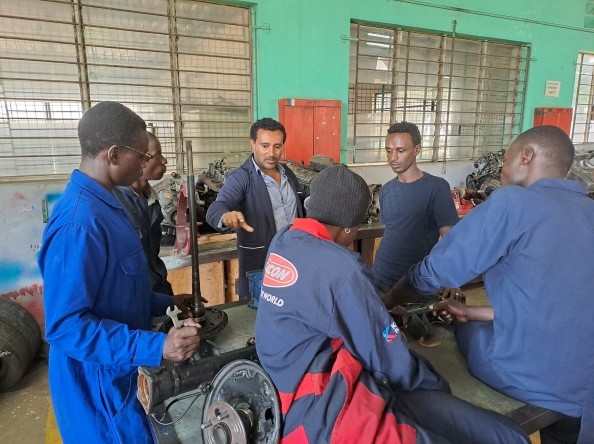
The Dean, Kombolcha Polytechnic College, Mr. Ermias Getnet, with students and trainers at an automative workshop at Kombolcha Polytechnic College
So far, about 1,177 students have taken part in both short-term and long-term exchange programmes across the 16 TVET centres under EASTRIP, a significant increase from just 30 students at the project’s inception. The number of teaching staff who participated in exchange programmes at TVET institutes in another country increased from 0 at baseline to 239, underscoring the growing importance of cross-border knowledge sharing in teaching and learning of TVET programs.
“This growth highlights the project’s success in promoting regional integration and enhancing the quality of technical and vocational education in East Africa,” said Dr Cosam Joseph, the Regional Project Coordinator for EASTRIP at Inter-University Council for East Africa (IUCEA).
Through EASTRIP, countries in East Africa have also developed the Regional TVET qualifications framework for Ethiopia, Kenya and Tanzania, to standardise and harmonise the levels and quality of technical and vocational qualifications across the three countries. It means a diploma or certificate earned in Ethiopia, Kenya, or Tanzania carries comparable weight, making it easier for employers and institutions in any of these countries to understand, accept, and value it.
“The qualifications framework removes barriers to mobility for graduates and workers, opening up regional employment opportunities and enabling labour to move where demand is highest,” Dr. Cosam said.
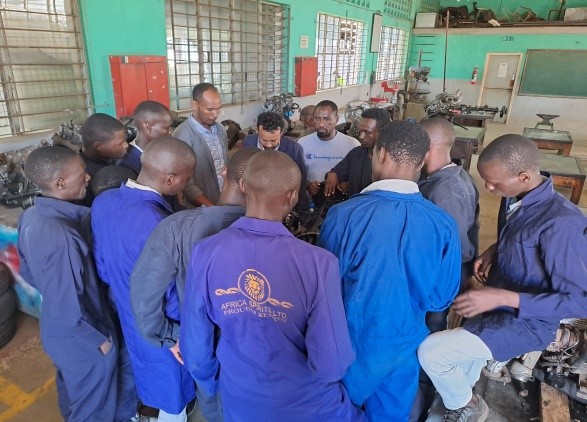
For instance, Kombolcha Polytechnic College in Ethiopia has been sending its trainers to TVET institutions across East Africa to share knowledge and explore new teaching methods in other countries. Recently nine trainers returned from their exchange programmes at Kisumu Polytechnic College with new knowledge and renewed vision of what teaching can be. The instructors were tasked with learning the latest developments in automotive technology and teaching methodologies, to bring those insights home to transform their own classrooms.
Among them were Mr. Ali Fenta, the Head of Department of Automotive Technology and Mr. Suleyman Seid, a trainer in the same department. They were placed at Kisumu National Polytechnic College in Kenya, one of the country’s premier centres for technical education.
At Kisumu, the trainers immersed in intensive, hands-on training that connected theory to real-world applications. Fenta says, “We were actively involved, troubleshooting and working alongside Kenyan trainers. It pushed us to rethink how we teach and how we prepare our students for the demands of the industry.”
Ali, recalling how Kenyan students debated solutions, sometimes even challenging instructors respectfully. “Student weren’t just memorising; they were solving problems on their own.”
For Suleyman, the biggest lesson was about trust. “In Kenya, teachers gave students space to try, to fail, and try again. That’s how confidence grows. It changed how I see my own role.”
At Kombolcha, the trainers have redesigned lessons around hands-on tasks and initiated partnerships with local industry, securing internships that pushed learning beyond the college’s gates.
By Godwin Bonge Muhwezi, Project Communication Specialist for EASTRIP at IUCEA and Assen Bushira, M&E Specialist for EASTRIP at Kombolcha
