
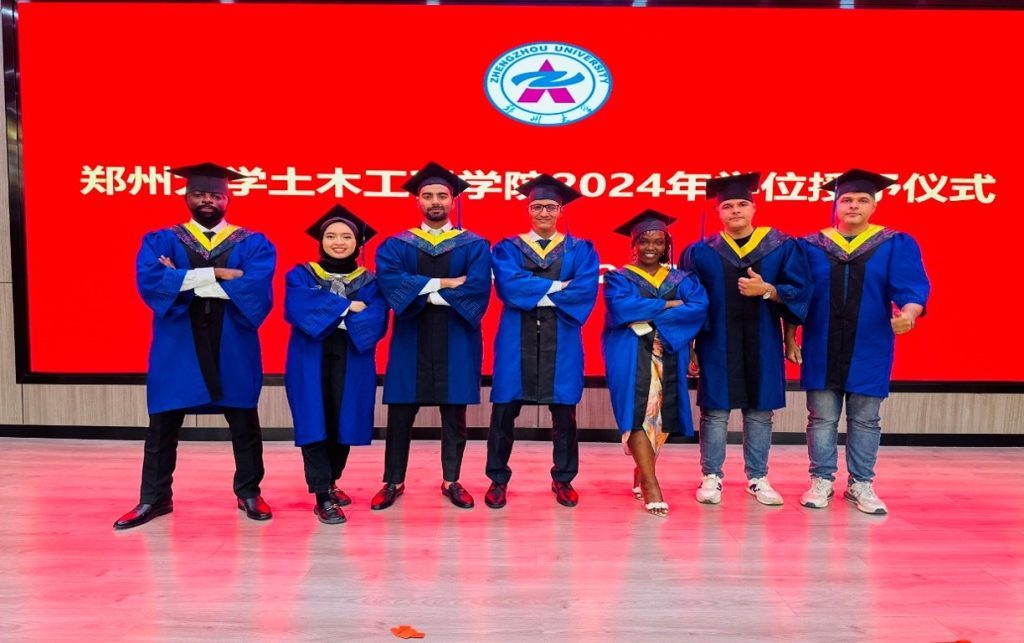
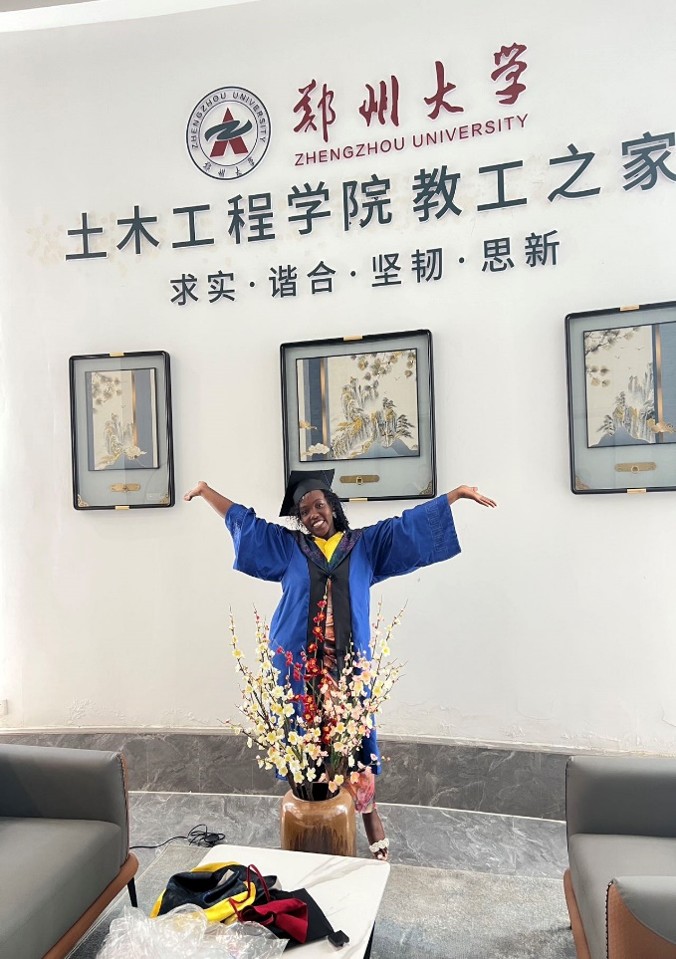
Through the EASTRIP-China TVET Scholarship, Hazel Faith Gacheri, a Kenyan engineer, driven by a passion for sustainable infrastructure, has built a firm foundation in Mechatronics and Civil Engineering. She hopes to bridge advanced global engineering practices with the evolving technical education needs of her home country. Below she shares her story.
I am a mechatronics engineer by training, a teacher by experience, and a civil engineer at heart. For most of my career, I have moved between these identities never quite sure which one was the “real” one.
The EASTRIP–China TVET Scholarship Programme gave me the answer: all of them. And more importantly, it showed me why that intersection is exactly where transformative education needs to live.
Through this programme, I was able to cross disciplines and pursue Civil Engineering and Construction Management at Zhengzhou University in China. What followed was a complete re-examination of how I understand learning, labour markets, and the infrastructure of opportunity.
Engineering problems are rarely confined to a single discipline. They require a synthesis of knowledge, methods, and perspectives and so must the systems that train the people who solve them.
What China’s TVET System Taught Me
One of the most striking things I observed in China was the deliberate, almost architectural relationship between curriculum and industry. Training programmes are co-created with industry and carefully structured so that every competency unit maps to a real economic need. The lesson is clear: a curriculum that does not evolve with the sector it serves is already out of date.
Research facilities were designed as active partnerships with industry, co-funding experiments and co-developing solutions. The line between “learning environment” and “production environment” was deliberately blurred. Students contribute to live research with actual stakes. This is the model that should be informing TVET policy conversations across Africa.
Looking back at home, I see encouraging signs. The rollout of Competency-Based Education and Training (CBET) and the Dual Curriculum in Kenya’s TVET institutions signals that we are moving in the right direction toward frameworks that prioritise demonstrable skills over seat time, and that bring the workplace into the training environment.
What Culture Taught Me That Classrooms Couldn’t
Living and studying in China as a Kenyan woman added a dimension to this experience that no curriculum could have designed. The “global village” is a phrase we use easily but actually inhabiting it, navigating daily life in a language and cultural context entirely unlike your own, changes how you think.
It starts with the small things. The pepper is sharper than anything back home. The dumplings steaming at 6am outside the campus gates become, over time, your breakfast. You learn to navigate a wet market by pointing and smiling. You discover that hotpot is less a meal and more a social ritual hour around a bubbling pot, adding, tasting, laughing, arguing. Food, it turns out, is one of the fastest routes into a culture.
Then come the festivals. Spring Festival transformed the city in ways I had never seen a city transform weeks of red lanterns, the percussion of firecrackers, families moving across the country in the world’s largest annual human migration, all to sit together and eat. The Mid-Autumn Festival brought mooncakes and the quiet ritual of looking at the same moon that everyone, everywhere, was also looking at.
The music stayed with me too, the energy of street performers in the old quarters, to the K-pop and Mandopop blasting from every corner. Every morning and every evening, the ayi’s (older women), unhurried and utterly unbothered claim the streets and squares for their own, dancing in formation to music from a portable speaker, radiating a kind of communal joy that no itinerary could have prepared me for.
I learned that the way a society approaches education is inseparable from the way it approaches collective progress. In China, there is a deeply ingrained cultural value placed on discipline, long-term thinking, and the idea that individual excellence serves a larger purpose. This shapes everything from how students engage in lectures, to how researchers approach a problem, to how institutions define success.
The cross-cultural exchanges I experienced with peers from across Africa, Asia, and beyond also surfaced something important: we share far more challenges than our different geographies suggest. Skills gaps, misalignment between education and industry, the undervaluing of technical work these are not uniquely African problems. They are global ones. And that means the solutions can travel, too, if we are willing to learn from each other with genuine curiosity rather than defensiveness.
For me personally, living across cultural boundaries also reinforced that complexity is a strength. Being Kenyan in China, being an engineer who teaches, being a practitioner who researches none of these are contradictions. They are assets, especially in a world that increasingly requires people who can hold multiple perspectives at once.

The Stakes for Africa Are High
Africa’s infrastructure deficit is well-documented. But less discussed is the parallel skills deficit that constrains our ability to close it. We cannot build roads, energy systems, water networks, and digital infrastructure without a deep bench of technically skilled professionals who are trained not just theoretically, but practically people who have worked in environments that mirror the complexity of real projects.
TVET is not a consolation prize for students who “didn’t make it” to university. It is a critical pipeline for the engineers, technicians, project managers, and innovators who will determine whether Africa’s infrastructure ambitions are realised. The sooner our education policies reflect this in funding, in curriculum design, in institutional prestige the faster we close the gap.
Research as Responsibility
My time in China has deepened my commitment to research as a form of public service. Peer-reviewed contributions are how we build the evidence base that informs better policy. My own contribution to an SCI-indexed journal publication was a reminder that practitioner-researchers have a unique vantage point: we see the problems from the inside.
I was also offered a fully funded PhD scholarship an outcome I could not have anticipated when I began this journey. When the right investment is made in a person at the right moment, the returns compound.
What I am Taking Forward
I want to contribute to curriculum design that is genuinely industry-responsive. I want to support institutions that treat skills development as a strategic national asset. And I want to help build research ecosystems where African practitioner-researchers generate the knowledge that shapes African policy not the other way around.
The EASTRIP programme is not just investing in individuals. It is investing in the connective tissue between education, industry, and sustainable development. That connective tissue is what skilled, future-ready economies are made of.
