
For years, poor road conditions have stood in the way of progress, cutting off families from markets, health services, and schools in Meru County in Kenya. To solve the persistent problem, a capacity-building programme was initiated.
The initiative, funded by the Japanese Social Development Fund (JSDF) and implemented in partnership with Community Road Empowerment (CORE) and the Government of Kenya, is designed to build local capacity by equipping small-scale contractors with vital road maintenance and business management skills.
The training focuses on Routine Maintenance and Do-Nou Technology, a method that strengthens weak road sections using soil-filled bags and locally available materials. Kenya Institute of Highways and Building Technology (KIHBT) is serving as the technical training provider. One of the key objectives of the East Africa Skills for Transformation and Regional Integration Project (EASTRIP), funded by the World Bank, and governments of Ethiopia, Kenya and Tanzania, is to support TVET institutions enter into partnerships and activities for income generation.
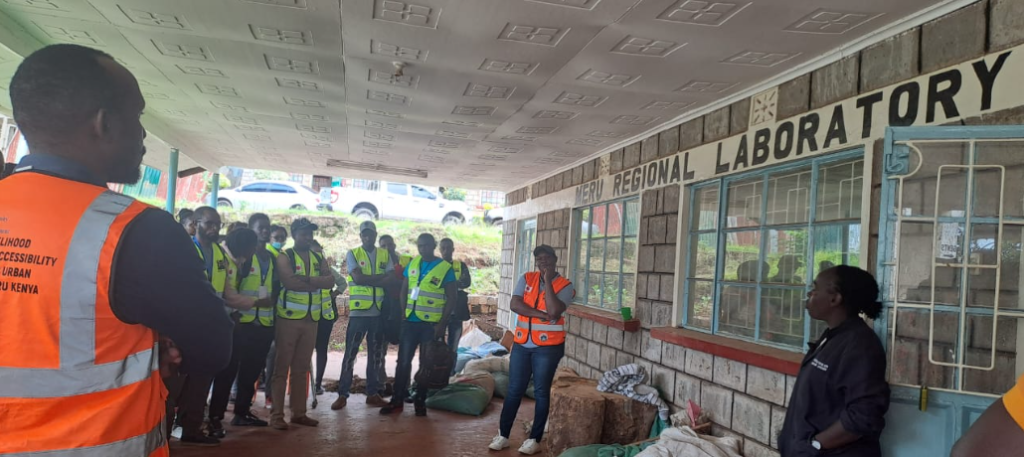
Participants during the introductory session at the KIHBT materials lab
The broader goal of the training programme is to promote local enterprises that can maintain roads over the long term while also generating employment and improving the livelihoods of local communities.
The programme is structured into three key modules. The first covers routine road maintenance and Do-Nou technology, ensuring participants develop practical technical skills. The second module addresses contract administration, tendering, and critical cross-cutting issues such as financial management and compliance, preparing trainees to run competitive and sustainable businesses. The third component involves hands-on work on a designated demonstration road, where trainees practice planning, supervision, quality control, and reporting.
The theoretical segments of the training are taking place at Meru National Polytechnic, with practical materials testing conducted at the Materials Testing and Research Division (MTRD) in Meru. Practical field training is then carried out directly on the demonstration road.
One hundred contractors were pre-selected for the programme and divided into two cohorts of fifty. The first cohort began training on May 5, 2025. Each group will undergo a three-week curriculum, including two weeks of classroom instruction and one week of intensive fieldwork.
CORE is overseeing the overall coordination of the training programme, including procurement of tools, materials, and labour, as well as management of the demonstration road.
Local leaders have welcomed the initiative, highlighting its dual impact on infrastructure and economic empowerment. “This programme is not just fixing roads, it’s building the skills of our people and strengthening local businesses,” said a Meru County official.
As the first cohort nears completion, organisers say they hope the project will serve as a model for similar capacity-building efforts across Kenya, demonstrating how targeted technical training combined with practical business skills can empower communities to take charge of their own development.
By Beatrice Njenga, Communication Officer, EASTRIP at KIHBT
