
For more than two decades, Dr. Eng. Abdulkerim Mohammed Aman’s career has moved across some of the most demanding areas of transport infrastructure, from road and bridge construction in Ethiopia to the management of major railway projects and, most recently, advanced research in smart construction technologies.
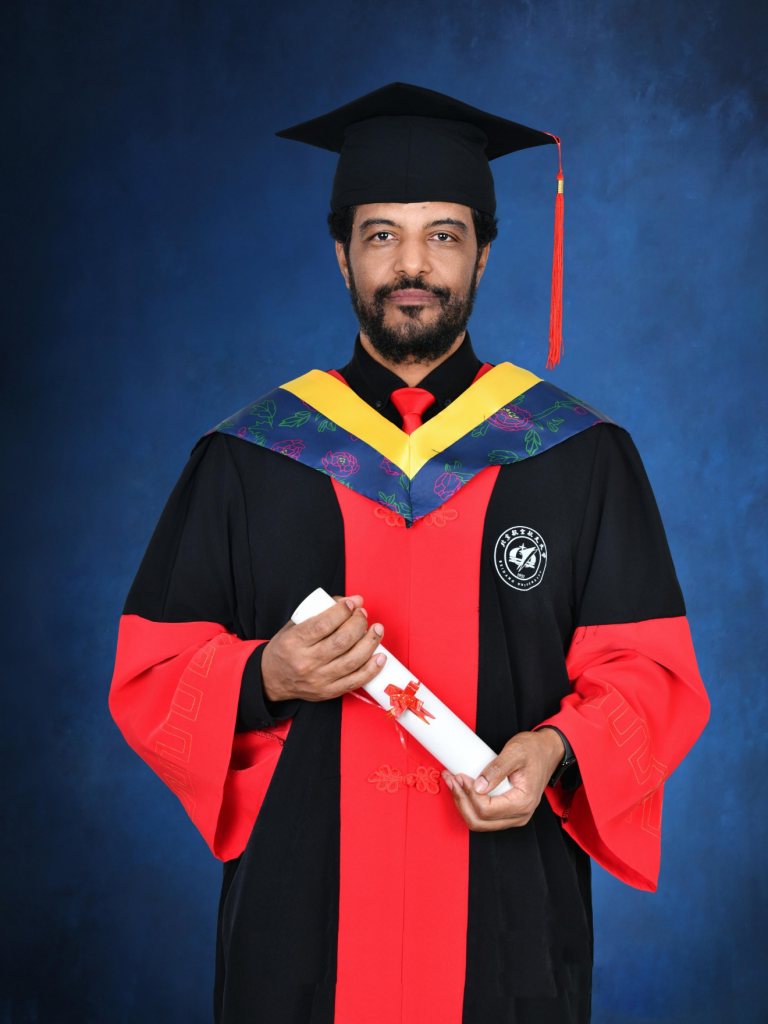
With support from the EASTRIP-TVET Scholarship, a partnership between Inter-University Council for East Africa through the East Africa Skills for Transformation and Regional Integration Project (EASTRIP), the World Bank and the People’ Republic of China through the China Scholarship Council (CSC) and EASTRIP, he pursued doctoral studies at Beihang University in China.
He built on extensive professional experience with the Ethiopian Railways Corporation and previous postgraduate training in Russia. His PhD research explored cost-saving approaches to 3D concrete printing, an emerging technology with potential applications in faster, more efficient and increasingly automated infrastructure development.
In this interview with the EASTRIP Skills Bulletin, he reflects on his academic and professional journey, the experience of studying in China, the transition from managing large infrastructure projects to advanced research, and how he plans to apply his knowledge to railway development, regional integration and the training of the next generation of East African engineers.
- What was your academic and professional journey before receiving the CSC scholarship, and how did the opportunity through EASTRIP change the direction of your career?
My journey began with a Bachelor of Science in Civil Engineering from Arba Minch University in 2005. I immediately entered the field, supervising road and bridge construction for Amhara Rural Roads and later serving as a project manager, District Manager, and ultimately Deputy CEO and General Manager of the Amhara Road Works Enterprise.
Driven to specialize, I completed my Master of Science (MSc) in Railway Road Design and Construction at the Emperor Alexander I St. Petersburg State Transport University in Russia (2010–2013). Upon returning, I spent roughly 11 years as a Project Manager for the Ethiopian Railways Corporation, directing the landmark $2.0 Billion USD, 390 km Awash–Kombolcha–Hara Gebeya Railway Project, where I managed the design strategy and a workforce of over 10,000 people. Between 2014 and 2020.
The opportunity through EASTRIP shifted my career from purely executive mega-project management into the frontier of advanced academic research. It bridged the gap between heavy field execution and cutting-edge transport technology, paving the way for my Ph.D. selectee status.
- What specific area did your PhD research focus on, and why is it important for the railway sector, transport systems, or skills development in East Africa?
My Ph.D. research at Beihang University focused on the School of Transportation Science and Engineering, with a specific research interest in cost-saving methodologies for 3D concrete printing.
While 3D concrete printing is traditionally viewed through a residential building lens, its structural and material principles are incredibly vital for the modern transport sector. For East Africa, where infrastructure demands are high but budgets are constrained, automated construction, rapid concrete fabrication, and material cost-efficiency are revolutionary. Applying these automated technologies can significantly lower construction costs, accelerate project timelines for transit facilities, and introduce a modern paradigm of high-tech skills development to East African engineers.
- What was the most challenging part of studying at Beihang University in China, and what helped you overcome it?
The most challenging aspect was navigating the highly advanced, rapidly evolving technological ecosystem and academic intensity at Beihang University, compounded by the initial language and cultural barriers of conducting high-level research in a new environment.
I overcame these challenges through sheer adaptability, intense focus, and collaboration. Working closely with institutions like China Three Gorges University provided a strong cooperative research framework, and the immense support from faculty and peers helped me quickly bridge the language gap and master advanced laboratory methodologies.
- How has the CSC scholarship and EASTRIP support strengthened your technical expertise, international exposure, and ability to contribute to your home institution or country?
The dual pillar of the CSC scholarship and EASTRIP support granted me unparalleled international exposure. Having studied at premier institutions in both Russia and China, I have gained a rare, global perspective on land transport engineering.
Technically, it shifted my capabilities from traditional civil engineering to automated, modern smart construction methodologies. This enables me to return to my home country not just as a manager of existing engineering standards, but as a pioneer capable of introducing advanced, cost-effective technologies to our national transport systems and academic institutions.
- Now that you have completed your PhD, how do you plan to apply your knowledge to support railway sector development, regional integration, or advanced technical training in East Africa?
I plan to adopt a multi-pronged approach. Professionally, I intend to re-engage with mega-infrastructure planning to integrate modern, automated, and cost-efficient building technologies into regional railway projects, driving smoother regional integration across East Africa. Academic-wise, I plan to leverage my research to establish advanced technical training presentations, mentoring the next generation of East African engineers in smart transport infrastructure, digital fabrication, and modern rail design.
- Beyond the classroom and laboratory, how would you describe your experience studying in China—the people, the culture, the language, and the lessons you gained from living in a different academic and social environment?
Living in China was an deeply enriching experience. The academic environment is incredibly fast-paced, which instills a strong culture of discipline, efficiency, and constant innovation. Beyond the university, I found the Chinese people to be remarkably welcoming, industrious, and community-oriented. Immersing myself in the language and vibrant local culture taught me that true engineering innovation requires diverse perspectives. The experience has made me a more globally minded professional.
- What message would you give to other EASTRIP scholars or young professionals considering advanced studies in railway engineering and related fields?
My message to young professionals and fellow scholars is simple: Embrace the challenge of the unknown. The infrastructure landscape is shifting from traditional construction to smart, automated, and sustainable engineering. Do not limit yourself to the classroom; seek out interdisciplinary research, stay highly active in professional networks, and remember that the knowledge you acquire abroad is the precise catalyst required to transform the transport and economic landscape of East Africa.
