
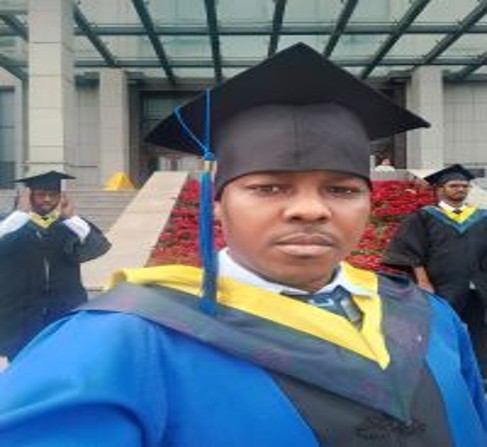
Martin Mulwa was supported by EASTRIP-China TVET Scholarship to pursue a Master’s degree in the highly specialized field of Design and Construction of Naval Architecture and Ocean Structures. He began at the height of the COVID-19 pandemic in September 2020. He navigated years of rigorous virtual learning and cross-time-zone collaborations from Kenya, before finally transitioning to vital in-person training in China in March 2023. Below, Martin shares his story.
My master’s journey began in September 2020 under unprecedented circumstances. Due to the COVID-19 pandemic and subsequent global travel restrictions, I commenced my studies online. This period required immense self-discipline, as I attended virtual lectures and collaborated on design projects across multiple time zones. The theoretical foundation laid during this time was crucial, but the true academic experience began when I finally travelled to China in March 2023. I arrived as winter was ending and spring was approaching, the snow was melting, symbolizing a new beginning and the long-awaited start of my in-person learning adventure.
State-of-the-Art Facilities at Harbin Engineering University (HEU)
Upon arrival, I was immediately impressed by HEU’s world-class infrastructure. The university is renowned for its naval architecture and ocean engineering programs, and the facilities exceeded my expectations:
Simulation Facilities
The most remarkable resource was the full-mission ship maneuvering simulator and the deepwater offshore engineering simulation centre. These labs allowed real-time modelling of vessel behavior in extreme ocean conditions (high waves, ice, and currents). We conducted virtual towing tank experiments and dynamic positioning simulations, bridging the gap between theoretical design and real-world performance.
Towing Tank and Hydrodynamics Lab
The university’s large-scale towing tank, equipped with high-speed cameras and wave generators, enabled precise testing of hull forms and propulsion systems.
Structural Testing Lab
Advanced fatigue and impact testing machines were used to analyse composite materials for ocean structures, critical for my research on naval architecture durability.
Harbin (The Ice City and Its Wonders)
Harbin, known as the “Ice City of China,” provided a unique and unforgettable backdrop to my studies.
Although I missed the festival during my arrival in early 2023, I was fortunate to witness it in January 2024 before leaving China. The festival was nothing short of magical—entire castles, ships, and famous world landmarks sculpted from ice harvested from the Songhua River, illuminated with neon lights. Walking through the Ice and Snow World felt like stepping into a frozen fairy tale. This experience remains one of the most spectacular cultural events I have ever attended.
Rail Transport (Metro)
Harbin’s metro system was my lifeline for navigating the city. Efficient, clean, and punctual, the metro connected HEU to the city centre, railway station, and major attractions. The stations themselves were architectural marvels, some featuring Soviet-inspired chandeliers and murals depicting Harbin’s history. The metro taught me the value of well-planned public infrastructure.
Beautiful Summer Season
Having only experienced Harbin’s winter and spring, I stayed long enough to witness the summer of 2024. The contrast was astonishing—the same city that had been buried in snow transformed into a lush, green paradise with pleasant temperatures around 25°C. The Songhua River became a hub of activity, with locals swimming, dancing in public squares, and enjoying open-air concerts. Summer in Harbin showed me the city’s vibrant, joyful soul.
Chinese Festivals
I celebrated the Mid-Autumn Festival with university friends, sharing mooncakes and admiring the full moon. During Dragon Boat Festival, I watched traditional boat races on the Songhua River and learned to make zongzi (sticky rice dumplings). The Spring Festival (Chinese New Year) was spectacular—firecrackers, red envelopes, and the famous Spring Festival Gala on television.
Mandarin Language Short Course
The university offered a short Chinese Mandarin course for international students. I learned basic greetings, numbers, and essential phrases like “Duō shǎo qián?” (How much?) and “Zhè ge duō dà?” (How big is this?). This modest language skill helped me navigate markets, order food, and build rapport with local professors and students.
Change of Meal Times
One of the biggest adjustments was the earlier meal schedule. In China, lunch is typically served around 11:30 AM to 12:00 PM, and supper as early as 5:30 PM. Initially, my East African body clock struggled with this, as I was used to lunch at 1:00 PM and supper after 8:00 PM. However, I adapted by carrying small snacks (nuts and fruit) to bridge the gap, and eventually came to appreciate how this schedule aligns with a productive workday.
Workshops and Professional Engagement
The most enriching aspect of my in-person study was the exposure to maritime professionals through workshops and seminars:
Royal Institution of Naval Architects (RINA) Events
I was privileged to attend RINA China Division technical meetings and workshops held at HEU. These sessions covered cutting-edge topics like ice-class vessel design, autonomous ships, and green shipping technologies. Presenting my own preliminary research on ocean structures to RINA members was a career-defining moment.
Maritime Professional Presentations (Conferences)
Regular seminars featured experts from China State Shipbuilding Corporation (CSSC), classification societies (ABS, DNV, CCS), and offshore engineering firms. Topics included: Arctic Shipping Routes and Icebreaker Design”; Digital Twins in Naval Architecture”; and Corrosion Control in Deepwater Structures”.
Collaborative Workshops
I participated in design hackathons where multinational teams solved real engineering problems, such as optimizing a semi-submersible platform for East African coastal conditions.
The international student community at HEU was a microcosm of the global maritime industry. My classmates came from Pakistan, Yemen, Iran, Philippines, Syria, Indonesia), and several other countries. I was the only student from Africa in my class. Key takeaways:
Cross-cultural teamwork
While working on group projects, I learned to navigate different communication styles—direct vs. indirect, hierarchical vs. egalitarian. For instance, my Russian classmates had deep practical knowledge of icebreakers, while Nigerian peers excelled in tropical offshore design.
We celebrated Chinese New Year together, shared traditional dishes (I introduced Ugali and Nyama Choma to my Chinese and Pakistani friends), and learned basic Mandarin for engineering terms. These interactions built lifelong professional networks and taught me that innovation thrives in diverse, inclusive environments.
The Chinese Professors
One of the most profound lessons from HEU came from observing and learning under my Chinese professors. Their attention to detail is not merely a professional habit, it is genuinely engraved in their DNA. Whether reviewing a ship hull design, checking a simulation input, or correcting a research paper draft, they would spot errors invisible to the untrained eye. A single misplaced decimal in a buoyancy calculation would be caught instantly.
A minor inconsistency in a materials testing report would be flagged and discussed at length. This meticulousness extended to punctuality, documentation, and even the formatting of citations. At first, I found it exhausting; but over time, I internalized it. Today, as HoD Maritime Studies, I apply the same rigorous attention to detail when reviewing our department’s curriculum, student assessments, and administrative reports. This Chinese academic discipline has become part of my own professional identity.
Leading the Maritime Studies Department
Today, as the Head of Department (HoD) for Maritime Studies, the central department of the Maritime School at my college, I draw daily upon the competencies gained at HEU. The advanced knowledge in naval architecture and ocean structures enables me to critically review and update our curriculum, ensuring it meets international standards. The hands-on exposure to simulation facilities inspired me to advocate for investment in similar maritime simulators for our own training labs, enhancing practical learning for our students. Furthermore, the workshops and RINA presentations taught me how to structure professional guest lectures and industry linkages, which I now organize to expose our students to real-world maritime professionals.
The cross-cultural management skills learned from working with multinational peers have proven invaluable in coordinating a diverse team of lecturers and administrative staff. The keen attention to detail modelled by my Chinese professors now guides my quality assurance processes. Finally, the resilience I developed—starting my master’s online during COVID-19, adapting to new meal schedules, navigating Harbin’s metro, and embracing four distinct seasons—has prepared me to lead my department through challenges, from resource constraints to curriculum reforms, with confidence and strategic vision.
Despite a challenging start due to COVID-19, my master’s study at Harbin Engineering University under the EASTRIP scholarship was transformative. The state-of-the-art simulation facilities, the breathtaking Ice and Snow Sculpture Festival, the efficient metro, the beautiful summers, the rich Chinese festivals, the early meal times, the Mandarin short course, professional engagement with RINA and maritime experts, daily cross-cultural learning, and above all, the meticulous mentorship of Chinese professors have equipped me not only with technical expertise in naval architecture and ocean structures but also with the leadership, discipline, and global perspective that I now apply daily as HoD of Maritime Studies.
I am deeply grateful to EASTRIP, the Inter University Council of East Africa, and HEU for this life-changing opportunity, which continues to bear fruit in my service to maritime education in East Africa.
