
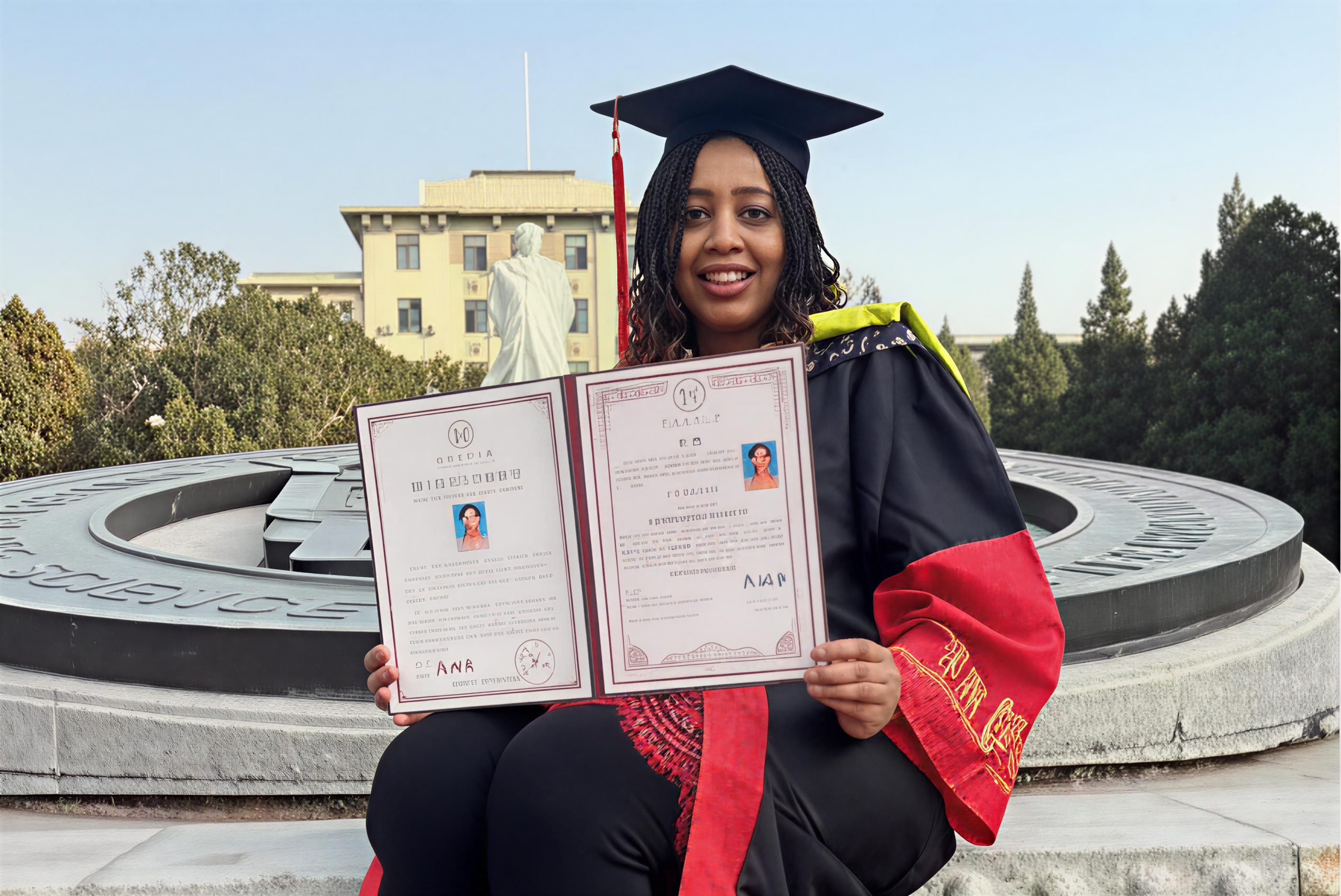
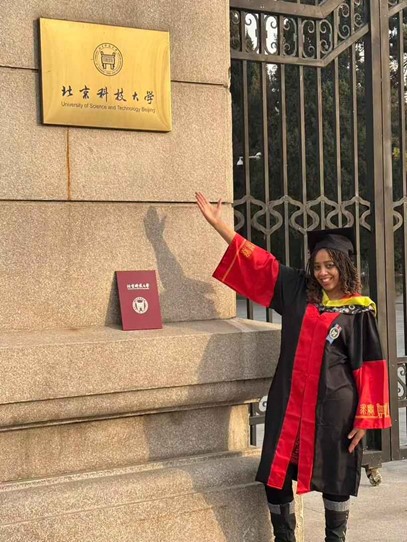
Investments in Technical and Vocational Education and Training (TVET) in East Africa are strengthening the capacity of institutions to deliver industry-relevant skills and support economic transformation. Through the EASTRIP–China TVET Scholarship, young lecturers are gaining advanced expertise and global exposure, equipping them to drive innovation and improve the quality of training systems across the region. In this issue, we share the story of Dr. Doreen Sebastian Sarwatt, a beneficiary of EASTRIP–China TVET Scholarship who recently graduated with a PhD in Computer Science and Technology from the University of Science and Technology Beijing (USTB) in China.
What motivated you to pursue a PhD in Computer Science and Technology?
My motivation was shaped by both my academic background and my experience as a lecturer at the National Institute of Transport (NIT) in Tanzania. Through my work, I observed persistent challenges in road safety and the limited integration of advanced technologies in transport systems.
These experiences led me to explore how emerging technologies, particularly artificial intelligence, could be applied to address real-world challenges. I became interested in how intelligent systems could improve safety and efficiency in transportation, an area that is increasingly important as countries modernise infrastructure and expand mobility systems.
Pursuing a PhD allowed me to move beyond teaching existing knowledge and contribute to generating new solutions. It was also an opportunity to build the advanced technical expertise required to support innovation in Tanzania’s transport sector and contribute to broader regional skills development priorities.
What challenges did you face during your studies, and how did the scholarship help?
The PhD journey was both demanding and transformative. One of the main challenges was conducting advanced research that required significant computational resources. Limited access to high-performance computing systems slowed progress, particularly for experiments involving complex machine learning models.
At the same time, I had to adjust to a new academic and cultural environment, including language barriers and the expectations of doctoral-level research. Balancing these demands required resilience, discipline, and adaptability.
The EASTRIP–China TVET Scholarship played a critical role in addressing these challenges. It provided not only financial support but also access to a high-quality research environment, advanced infrastructure, and academic mentorship. This enabled me to focus on my research, maintain progress, and complete my studies successfully.
More broadly, the scholarship reflects the importance of investing in human capital development within TVET systems, ensuring that instructors and trainers have access to advanced skills and global exposure.
How was your experience studying in China?
Studying in China gave me a high-quality academic and research environment that enhanced my learning experience. I was trained in a system that emphasises discipline, precision, and continuous improvement, which are essential values in both research and engineering practice.
Under the supervision of Prof. Huansheng Ning from University of Science and Technology Beijing and Prof. Jianguo Ding from Blekinge Institute of Technology, Sweden, I developed strong capabilities in research design, critical analysis, and applied problem-solving.
The programme also provided opportunities for practical exposure through engagements with industry stakeholders, including advanced railway systems such as the Beijing–Zhangjiakou Railway. These experiences helped bridge the gap between theory and practice and provided insights into how advanced transport systems are designed, implemented, and managed.
Interactions with an international student community further strengthened my adaptability and global perspective, which are important skills in collaborative research and regional integration contexts.
What key skills and knowledge did you gain?
My doctoral training focused on machine learning, with specialisation in adversarial machine learning, AI security, and intelligent transportation systems. My research addressed the reliability of traffic sign classification systems in autonomous vehicles, an area with direct implications for road safety.
I developed the capacity to design robust, real-time AI systems capable of detecting cyber-attacks and maintaining safe operation under constrained conditions, such as limited processing time and small visual inputs. This required integrating considerations of accuracy, efficiency, and system resilience.
In addition, I strengthened my ability to analyse system performance under uncertainty and design solutions that are reliable in real-world conditions. This included applying rigorous validation, benchmarking, and testing approaches, which are critical for deploying AI systems in safety-sensitive environments.
These skills are directly relevant to strengthening the quality and relevance of training within TVET institutions, particularly in emerging fields such as AI and intelligent systems.
What were your key achievements during your studies?
I graduated with a GPA of 3.8/4.0 while conducting research on AI safety for autonomous vehicles. My doctoral research, titled “Adversarial Defense for Traffic Sign Classification in Autonomous Vehicles,” developed a framework for detecting and responding to adversarial attacks in real time.
The research addressed key technical constraints, including real-time processing requirements, small-scale visual inputs, and system robustness. It contributes to ongoing efforts to improve the safety and reliability of autonomous systems.
My work resulted in several peer-reviewed publications and submissions in leading journals, including IEEE Transactions on Intelligent Transportation Systems and IEEE Transactions on Information Forensics and Security. I also contributed to the academic community through peer review and participation in international research networks.
How did the scholarship contribute to your academic and professional growth?
The EASTRIP–China TVET Scholarship was instrumental in my development as both a researcher and an educator. It gave me access to advanced training, research facilities, and international academic networks that would otherwise have been difficult to access.
Through this experience, I was able to build technical expertise, engage in collaborative research, and gain exposure to global best practices in engineering and technology. This has strengthened my ability to contribute to curriculum development, research, and institutional capacity building at NIT.
At a systems level, such investments contribute to strengthening TVET institutions by enhancing the quality of instructors, improving training relevance, and supporting the development of demand-driven skills aligned with industry needs.
What are your future plans?
My future plans are aligned with strengthening transport systems and skills development in Tanzania. In the near term, I will continue teaching and mentoring students at NIT, with a focus on developing practical, problem-solving skills.
I also plan to establish a research agenda focused on AI security and autonomous driving systems tailored to local contexts. This includes developing Tanzania-specific datasets and validation frameworks that reflect real transport conditions.
In the longer term, I aim to collaborate with industry and government to support the development of policies, standards, and safety frameworks for emerging intelligent transportation systems. This will help ensure that technological adoption is both safe and contextually relevant.
What message do you have for current scholarship beneficiaries?
I encourage them to fully utilise the opportunity provided by the scholarship. While the journey may present challenges, these are part of the learning process and contribute to building resilience and professional discipline.
Make effective use of the resources, mentorship, and exposure available to you. At the same time, remain focused on how the knowledge and skills you gain can contribute to your institution, your country, and the region.
Investing in your own development is also an investment in strengthening the broader skills ecosystem.
This interview was conducted by Godwin Bonge Muhwezi, the Project Communication Officer for EASTRIP at Inter-University Council for East Africa.
