
In August 2025, the East Africa Skills for Transformation and Regional Integration Project (EASTRIP) Team, comprising officials from Ministries responsible for TVET, the World Bank Task Team Leaders, and IUCEA staff visited Tanzania, Ethiopia, and Kenya to review the project implementation in the 3 countries.
The team noted that there was satisfactory progress in establishing the Regional Flagship TVET Institutes in the 3 countries ahead of the project closure in December 2026.
The mission began in Tanzania, where the government recently secured an additional USD 15 million to ensure TVET Institutes are fully equipped.
At institutes visited, including National Institute of Transport, Arusha Polytechnic College and the Dar es Salam Institute of Technology, classrooms and workshops were already taking shape, signaling a new dawn for young Tanzanians.
“The Regional Flagship TVET Institutes are creating opportunities for thousands of students who will now train on modern equipment, ready for industries that are growing in energy, transport, and manufacturing,” said Dr. Fredrick Salukele, the Director of TVET and the National Project Coordinator for EASTRIP at the Ministry of Education, Science and Technology.
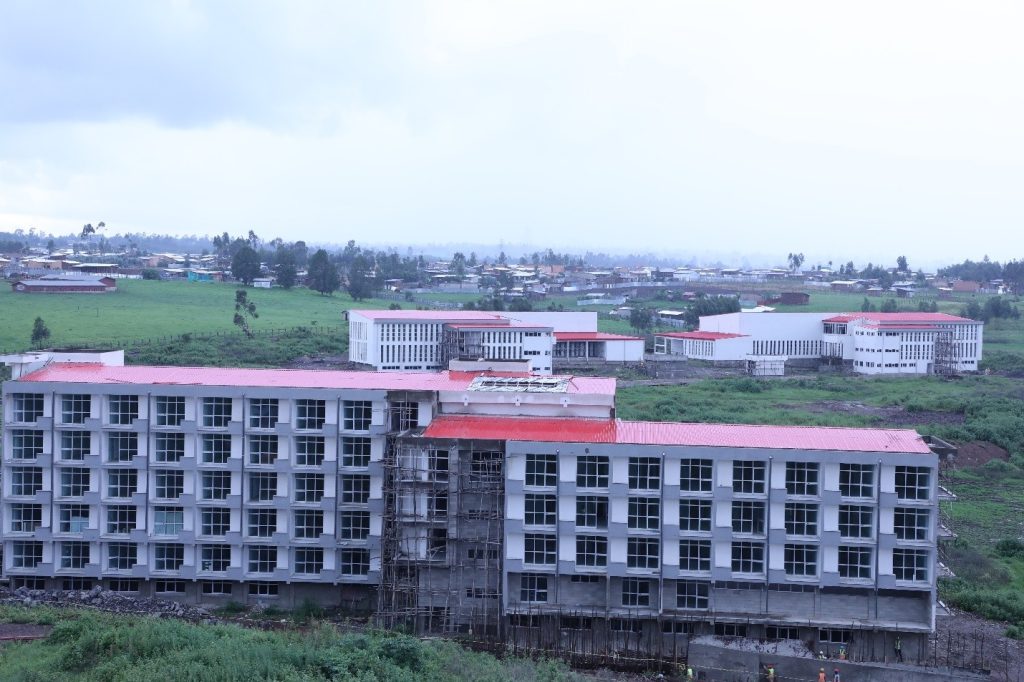
The Regional Flagship TVET Institute in Agro-Processing at Holeta Polytechic College in Ethiopia.
From Tanzania, the team moved north to Ethiopia, where the government has also received additional financing of USD 33 million, plugging funding gaps and bringing construction works close to completion.
The State Minister for TVET, Dr. Teshale Berecha, noted that EASTRIP has transformed Ethiopia’s TVET landscape, delivering “significant physical and digital infrastructure” and embedding new approaches into the country’s upcoming 10–20 year TVET strategy. “Within six months, we must conclude construction and move into operationalisation,” he said.
He observed that the TVET institutes in Ethiopia need to move towards sustainability, ensuring industry partnerships and government investments keep the centres alive long after donor funding ends.
For Ethiopia, EASTRIP is a foundation for the next generation of centres of excellence, capable of training tens of thousands of youths in sectors like engineering, construction, and renewable energy.
The team visited Kenya, where four out of five Regional Flagship Institutes are already 90 percent complete. The TVET institutes have invested in state-of-the-art facilities and obtained equipment to train the next generation of skilled labour.
The Principal Secretary for TVET, Ministry of Education in Kenya, Dr. Esther Muoria, challenged institutions to put emphasis on skills mapping, industry linkages, and sustainability models. “We must not just think outside the box, but remove the box entirely,” she said. “Through production, skills development, and industry linkages, we can transform the frustrations of unemployed youth into opportunity”.
She noted the need to embed investors directly into TVET Institute, so that students learn on live production lines while industries benefit from trained technicians. Examples like revived cotton processing partnerships at Kisumu Polytechnic College show how training can be tied directly to market demand.
A Regional Impact
For IUCEA and the World Bank, the mission reaffirmed EASTRIP’s impact across the three countries. The Regional Coordinator for EASTRIP Dr. Cosam Joseph praised the progress but warned of the dangers of unfinished business.
“We have an opportunity to ensure that all 16 centres in the region become examples of TVET transformation in the region. This generation, and future ones, will celebrate us if these centres deliver fully on their original mandate,” Dr. Cosam said.
The EATRIP Team noted that there was strong government commitment and concrete steps to close gaps funding gaps. Construction is near completion, equipment is arriving, and sustainability plans are taking shape.
As EASTRIP nears its final stretch, the focus is shifting from physical infrastructure to ensuring the long-term sustainability of its initiatives, measured by the employability of graduates, the strength of industry partnerships, and the ability of countries to collaborate in nurturing a resilient regional workforce.
By Godwin Bonge Muhwezi, Project Communication Specialist for EASTRIP at IUCEA.
